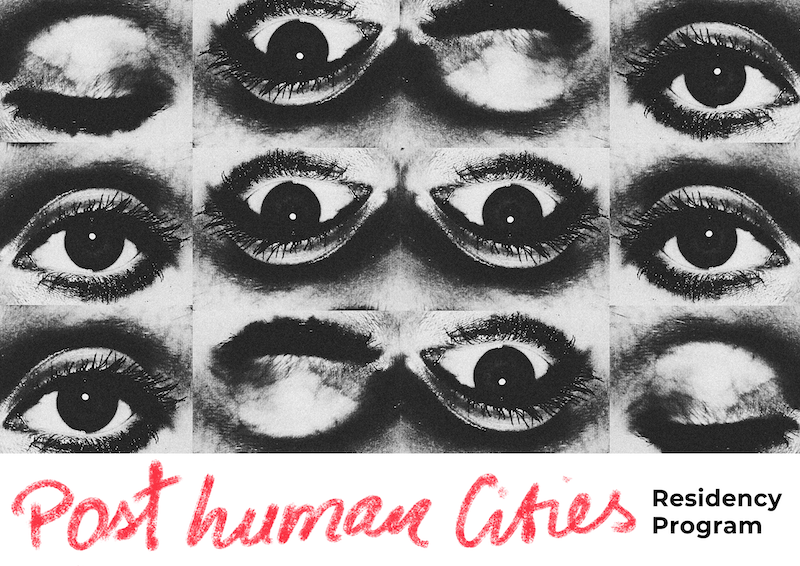
Post Human Cities Residency Program
Themes related to the World Congress of Architecture, Barcelona 2026.
The post-human city can no longer be thought of simply as a smart city. It is a living network of organic, technological, algorithmic, mineral, energetic, and affective agents that coexist, negotiate, and mutually transform one another. In this city, intelligence—both artificial and human—and nature blend into hybrid physical-digital phenomena, where sensors, data, bacteria, networks, bodies, clouds, and AI systems generate new ecologies of relationship.
Call for entries deadline: March 16, 2026
Program start: April 6
Exhibition opening: April 24
Program end: May 1
To learn about details, prices, and what our residencies include, please follow the link below:
This is a call for artistic and spatial practices that investigate without certainties, that open themselves to the intersectional, to the alliance between the living and the non-living; practices that design the city as a sensitive ecosystem, as a network of mutual dependencies, as a choreography between species, machines, and territories.
Below are the main issues of this theme and inspirational references:
1. THE AGENCY OF THE NON-HUMAN
Sensors, bacteria, artificial intelligences, atmospheres, infrastructures
The post-human city recognizes that action no longer belongs solely to humans. Sensors that measure, bacteria that metabolize, algorithms that decide, climates that alter, and technical systems that modify behavior constitute a field of distributed agencies where the non-human actively participates in the production of space and experience.
- Artistic References: Pierre Huyghe (After ALife Ahead), Anicka Yi (Life Is Cheap), Ryoji Ikeda (Test Pattern).
- Architectural/Urban References: Environmental sensor infrastructures, living architectures with integrated biological processes (metabolic facades, bio-reactors).
- Key Authors/Artists: Pierre Huyghe, Anicka Yi, Bruno Latour, Donna Haraway, Ryoji Ikeda.
2. THE PHENOMENOLOGY OF DATA
How it feels to be measured, indexed, tracked, predicted
Data becomes a perceptive layer of the city. Bodies no longer just feel space; they are continuously translated into information, converted into profiles, patterns, and probabilities. The urban experience now includes the sensation of being observed by non-human systems.
- Artistic References: Rafael Lozano-Hemmer (Pulse Index), Hasan Elahi (Tracking Transience), Hito Steyerl (How Not to Be Seen).
- Architectural/Urban References: Facial recognition systems in public spaces, urban predictive models.
- Key Authors/Artists: Hito Steyerl, Rafael Lozano-Hemmer, Hasan Elahi, Shoshana Zuboff, Kate Crawford.
3. THE ARCHITECTURE OF CONTROL
Cameras, data centers, satellites, clouds, platforms
Architecture no longer just organizes bodies: it organizes information flows, massive data storage, and planetary surveillance systems. Data centers, satellites, undersea cables, and digital platforms constitute a new monumentality of power.
- Artistic References: Trevor Paglen (The Other Night Sky), Forensic Architecture (Cloud Studies), Hito Steyerl (Surveillance as Infrastructure).
- Architectural/Urban References: Data centers as the new cathedrals of digital capitalism, algorithmic urban control platforms.
- Key Authors/Artists: Trevor Paglen, Forensic Architecture, Benjamin Bratton, Paul Virilio, Hito Steyerl.
4. THE CITY AS AN INTERFACE
Screens, signals, biometrics, geolocation
The city becomes an interactive surface: urban screens, smart signaling systems, real-time maps, biometric sensors, and augmented reality layers configure a city that responds, communicates, and reacts continuously.
- Artistic References: Rafael Lozano-Hemmer (Surface Tension), Blast Theory (Can You See Me Now?), Christa Sommerer & Laurent Mignonneau (Interactive Plant Growing).
- Architectural/Urban References: Adaptive smart signage, augmented urban spaces.
- Key Authors/Artists: Rafael Lozano-Hemmer, Blast Theory, Lev Manovich, Benjamin Bratton.
5. THE CRISIS OF THE SOVEREIGN SUBJECT
Expena-tech bodies, algorithmic identities, techno-political subjectivities
The subject is no longer defined only by consciousness and will, but by their inscription in databases, platforms, biometrics, and predictive profiles. The body is an interface, an archive, and a territory of capture.
- Artistic References: Stelarc (Exoskeleton), Zach Blas (Facial Weaponization Suite), ORLAN (The Reincarnation of Saint-Orlan).
- Architectural/Urban References: Biometric control at borders and public buildings, urban identities defined by mobility and consumption data.
- Key Authors/Artists: Stelarc, Zach Blas, ORLAN, Rosi Braidotti, Byung-Chul Han.
6. INTERSPECIES SYMBIOSIS
Humans, fungi, insects, machines, climates
The post-human city emerges as a fabric of ecological and technological relationships between species, where survival depends on cooperation between living organisms, machines, and atmospheres.
- Artistic References: Tomás Saraceno (Aerocene), Alexandra Daisy Ginsberg (Pollinator Pathmaker), Natalie Jeremijenko (OOZ).
- Architectural/Urban References: Architecture for pollinators, urban infrastructures adapted to extreme climates and biodiversity.
- Key Authors/Artists: Tomás Saraceno, Alexandra Daisy Ginsberg, Natalie Jeremijenko, Anna Tsing, Donna Haraway.
7. CARE
Infrastructures of care vs. infrastructures of extraction
In contrast to the city governed by efficiency, data, and capital, practices emerge that conceive technology as an infrastructure of care, oriented toward sustaining life, cooperation, and ecological and social regeneration.
- Artistic References: Mierle Laderman Ukeles (Touch Sanitation), Futurefarmers (Seed Journey), Theaster Gates (Dorchester Projects).
- Architectural/Urban References: Cooperative urban gardens, self-managed community centers, common-pool resources (water, energy, data).
Key Authors/Artists: Mierle Laderman Ukeles, Futurefarmers, Theaster Gates, Silvia Federici, Vinciane Despret.
How to apply?
Send an email to spacehaah@gmail.com including:
- CV and artistic experience.
- Copy of your passport (valid for at least 3 months after the residency).
- Portfolio (images, video links, or social media).
- Project proposal (summary, technical requirements, sketches, or references).

Deja una respuesta