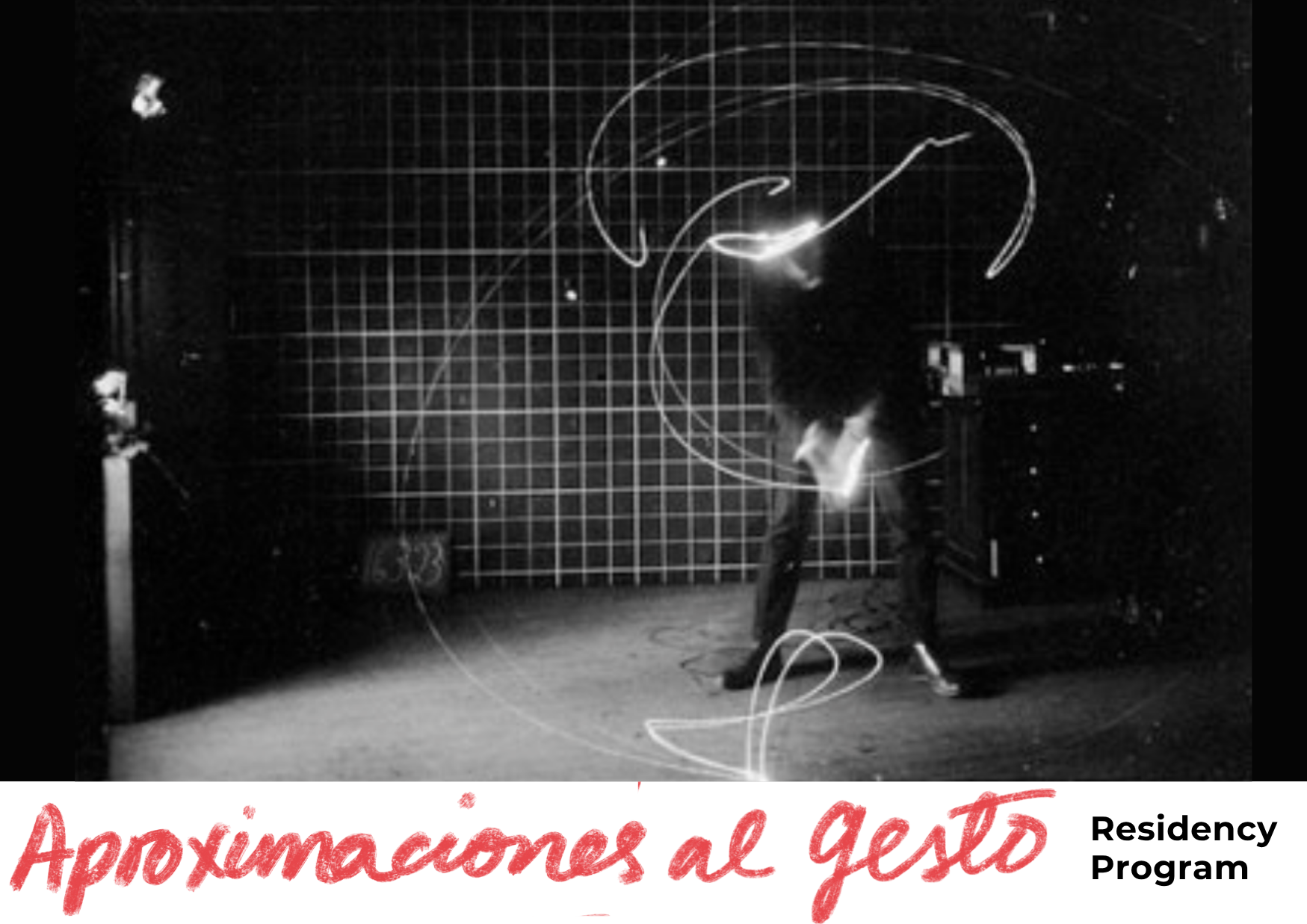
Gesture
What does a hand hold when it closes before speaking? What does a body say when it hesitates, repeats, or stops halfway through a gesture? Gesture is, at once, the body’s most intimate expression and the most public sign of a culture: it is inherited, conditioned, standardized, and, at times, lost.
The theme of this artist residency encompasses both the minimal, involuntary gesture and collective choreography. It invites the creation of works that slow down, repeat, deconstruct, or disrupt the gesture, rendering it visible to those who no longer perceive it.
Application Deadline: Oct. 2, 2026
Program Start Date: Oct. 12
Exhibition Opening: Oct. 29
Program End Date: Nov. 6
Read calendar
To learn more about details, fees, and what our residencies include, please follow the link below:
Read Open Call Details
Below, we present the key conceptual inquiries framing this theme, alongside inspirational references:
1. THE GESTURE AS A PERCEPTUAL EVENT.
The insurgency of the lived body and motor understanding prior to judgment.
Gesture is not the visible translation of an interior thought: it is the locus where perception, intention, and world are articulated simultaneously. Before becoming a sign, gesture is already a way of being in space—a means of gauging the distance between the body and things. The pre-reflective gesture operates before discursive thought and judgment take shape.
Artistic References
–Bruce Nauman — Bouncing in the Corner (1968). Repetitive movement pushed to the point of exhaustion as a kinesthetic inquiry into bodily limits.
-Bas Jan Ader — I’m too sad to tell you (1971). Weeping and involuntary facial contraction as the physical eruption of an affection that overwhelms reflective discourse.
-Marina Abramović y Ulay — Light / Dark (1977). The rhythmic exchange of slaps, where the defensive blinking reflex and muscular contractions collapse conscious control.
Authors / Artists
Maurice Merleau-Ponty, Jean-Paul Sartre, Edmund Husserl, Bruce Nauman, Bas Jan Ader, Marina Abramović.
2. THE COMMUNICATIVE GESTURE, ORATORY, AND THE SOCIAL CONTRACT.
Social mediation for coexistence and resistance.
This thematic line encompasses both the minimal, involuntary gesture and collective choreography, the social contract, and the sacred. It is the most public sign of culture within us: gestures that are inherited, learned, standardized, and, at times, lost. Here, gesture does not merely illustrate symbolically; it consummates the idea in the physical act (such as the handshake, the vote, the oath, or prayer), originally serving as a choreography of disarmament and the containment of violence.
Artistic References
–Tania Bruguera — Tatlin’s Whisper #6 (Havana Version) (2009). Relinquishing the podium and the institutional microphone as a performative activation of civic gesture and state censorship.
-Joseph Beuys — How to Explain Pictures to a Dead Hare (1965). Adopting a priestly demeanor and ritual whisper to interrogate the esoteric transmission of meaning.
-Sanja Iveković — Triangle (1979). Four simple gestures executed on a balcony during a state visit, defying police protocol and exposing the violence of public surveillance.
Authors / Artists
José Gaos, Jean Brun, Pierre Bourdieu, Giorgio Agamben, Tania Bruguera, Joseph Beuys.
3. THE GESTURE OF CARE: THE CARESS
Touching, holding, accompanying.
Certain gestures neither produce nor communicate; instead, they sustain: the hand bandaging a wound, combing hair, or touching lips. The caress stands as the antithesis of predatory instinct and instrumental grasping. It is the supreme human gesture—seemingly insignificant, everyday, and private—through which one body recognizes another by divesting itself of all violence.
Artistic References
–Lygia Clark — Máscaras sensoriais (1967) y Rede de elásticos (1974). elational objects that replace visual contemplation with the therapeutic reactivation of touch and mutual care.
-Pina Bausch — Café Müller (1978). ancers with closed eyes stumble blindly through an obstacle-strewn space while another performer frantically rushes to clear chairs to break their falls, followed by iterative embrace sequences where one carries and strains to hold up the other’s collapse. The choreography stages the urgency of physical refuge and the fragility of mutual support in the face of abandonment.
-Felix Gonzalez-Torres — Untitled (Water) (1995): A hanging curtain of translucent light-blue beads installed across an entryway, prompting visitors to walk through and brush against the strands with their faces, necks, and hands. The contact evokes a gentle, non-invasive caress that restores touch as an act of sensitive hospitality, mourning, and bodily remembrance during the AIDS epidemic.
Authors / Artists
José Gaos, Edmund Husserl, Jean-Paul Sartre, Maurice Merleau-Ponty, Emmanuel Lévinas, Jean Brun, Lygia Clark, Marina Abramović.
4. THE AESTHETIC GESTURE
The stroke, the movement, and the note.
Across visual arts, dance, and music, gesture is the physical movement imprinted upon matter, space, or sound. In painting, it projects the velocity, fury, or delicacy of motion. A parallel dynamic unfolds in dance, where any instrumental use of the body is shed so that movement becomes an end in itself—exhausting and celebrating itself in its own happening. In music, it is the conductor’s gesture summoning sound into being, or the pianist’s hand traversing the keys.
Artistic References
–Jackson Pollock — Painting sessions filmed by Hans Namuth (1950). The dripping and whipping of pigment as a kinetic inscription of muscular energy across the canvas.
-Trisha Brown — It’s a Draw/Someone Does Move Me (2002). The choreographer draws with charcoal strapped to her feet and hands, merging the choreographic score with the graphic trace.
-Kazuo Shiraga — Challenging Mud (1955). The artist’s body wrestling with an amorphous mass of mud and cement, reducing the aesthetic gesture to primordial physical friction.
Authors / Artists
Mierle Laderman Ukeles, Mary Kelly, Silvia Giambrone, Silvia Federici, Dolores Hayden.
5. CHOREOGRAPHIES OF EVERYDAY SPACE AND THE CITY
The urban score: drifts, tactics, and disciplines of transit and dwelling.
Metropolitan space operates as a kinetic apparatus that paces, constrains, and prescribes the trajectories of bodies.
Artistic References
–Guy Debord y la Internacional Situacionista — La deriva (1956-1958). The technique of playful, erratic locomotion through the city to subvert predetermined routes engineered by the society of the spectacle.
-Francis Alÿs — Cuentos patrióticos (1997). Marching in single file leading sheep around the flagpole in Mexico City’s Zócalo, ironizing the choreography of the social flock.
-Vito Acconci — Following Piece (1969). The artist follows randomly chosen pedestrians through New York until they enter a private interior, subordinating his own path to that of the stranger.
-Mierle Laderman Ukeles — Touch Sanitation Performance (1979-1980). The artist traversed New York City shaking hands with over 8,500 municipal sanitation workers to thank them for their daily work. Sustained over months, this direct touch dismantled social aversion, dissolved class divides, and framed the handshake as an ethical recognition of the invisible labor sustaining the material life of the metropolis.
-Kimsooja — A Needle Woman (1999-2001). The artist stands completely still with her back turned in the center of packed pedestrian thoroughfares across Tokyo, Cairo, Delhi, and New York. Her motionless body functions as a needle that does not disrupt its environment, but rather compassionately weaves through and accompanies the human flow, absorbing urban friction through stillness and endurance.
Authors / Artists
Michel de Certeau, Walter Benjamin, Guy Debord, Francis Alÿs, Vito Acconci, Donald Norman.
6. UTILITARIAN GESTURES
Instruments, the interface as prosthesis, and neuromuscular technē.
The hand as the «instrument of instruments» in service of the intelligence that animates it: it is not the hand that manipulates, but the mind that guides it and shares its affinity. With the advent of digital devices and touchscreens, the creative gesture undergoes a radical minimization. The body loses tactile friction with the physical world, trapped in an interplay of encoded, abstract surfaces.
A tool thoroughly mastered (such as a hammer, a bicycle, or an iPad) ceases to be an external object and integrates into the lived body. The prosthesis amplifies specific dimensions of gesture while diminishing or atrophying others. Digitalization has fostered microgestures wherein human movement is co-designed by the physical architecture of the interface.
Artistic References
–Mierle Laderman Ukeles — Maintenance Art Tasks (1973). Sweeping, scrubbing, and maintaining museum steps to render visible repetitive and overlooked bodily maintenance.
-Richard Serra — Hand Catching Lead (1968). The continuous, frustrated muscular effort of a hand trying to snatch falling scraps of lead, laying bare biomechanical fatigue.
-Francis Alÿs — Paradox of Praxis 1 (Sometimes Making Something Leads to Nothing) (1997). The exhausting push of an ice block through city streets until its total melting, parodying poietic efficacy.
-Julien Prévieux — What Shall We Do Next? (A Sequence of Hand Gestures) (2006-2011). A choreographic and visual archive of interaction gestures patented by technology corporations well before the devices were built.
-Rafael Lozano-Hemmer — Pulse Room (2006). An interactive installation where gripping an interface with metal sensors translates heartbeats into a pulsating light choreography.
-Stelarc — Ping Body (1996). The artist’s body wired to muscle-stimulation electrodes triggered involuntarily by internet data traffic and remote network pings.
Authors / Artists
Jean Brun, Vilém Flusser, Maurice Merleau-Ponty, Mierle Laderman Ukeles, Richard Serra, Francis Alÿs, Don Ihde, Peter-Paul Verbeek, Robert Rosenberger, Julien Prévieux, Stelarc.
See recommended bibliography
¿Cómo aplicar?
Envía un correo a spacehaah@gmail.com con:
CV y experiencia artística.
Imagen de tu pasaporte (vigente al menos 3 meses después de la fecha de la residencia).
Portfolio (imágenes, links a videos o redes sociales).
Propuesta del proyecto (resumen, necesidades técnicas, bocetos o referencias).
Asunto del email:
«[Tu nombre] / Residencia Gesto en Haba ArtLab [Fechas]»



Deja una respuesta