Exploring Transitions
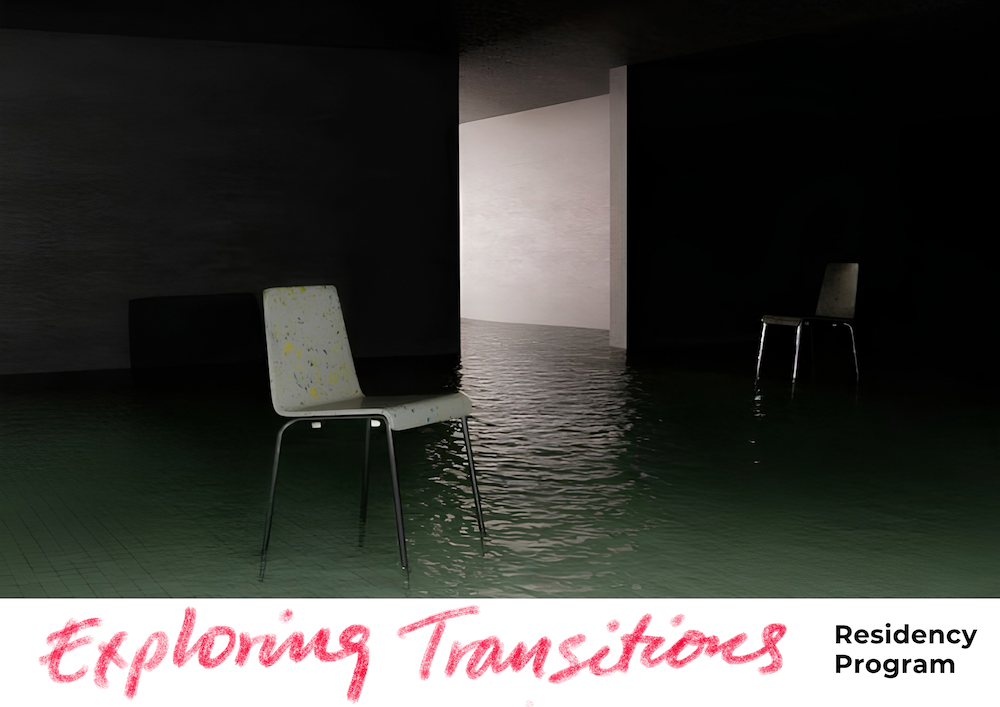
Located inside Haba ArtLab, our residency programs offer artists an opportunity to participate in a collective exhibition exploring the theme of “Exploring Transitions” through their work or research.
We inhabit a constant state of threshold—of liminality—marked by ecological crises, biopolitical transformations, technological acceleration, and geographic displacements. At this intersection of forces, the body inscribes itself and rehearses an inevitable biological transformation.
«Third places,» spaces of transit, waiting, and asylum. Within the notion of the «meanwhile» and liminality, friction, residue, uncertainty, and learning unfold as we inhabit this in-between space. This residency program invites artists and curators to explore transition—perhaps as a poetic, material, and political space of inquiry in its own right.
For details about price and what is included in all our residency programs please follow the link below:
Application Due date: December 20, 2026
Program starts: Genuary 18
Program ends: February 14
Read more: Full Residency Calendar / Half Residency Calendar
January 2027 // September 2027
Our goal is to advance the selected artists’ professional development by offering a supportive space for creative exploration of the theme Transitions. Up to 8 artists in residence will present their work in a collective exhibition open to local audiences.
Participants are encouraged to collaborate with local art professionals, propose talks and workshops, and delve into Barcelona’s rich socio-cultural environment.
Below, we outline the central questions surrounding this theme along with inspirational references:
1. LIMBO, NON-PLACES, AND THIRD LANDSCAPES.
Limbo represents the simultaneous coexistence within two or more geographies, affects, and cultural frameworks between which one moves. This section explores how transition zones and liminal spaces act as a suspension between two geographies or realities, giving rise to the notion of the «third landscape.»
Authors / Artists
Maurice Merleau-Ponty, Jean-Paul Sartre, Edmund Husserl, Bruce Nauman, Bas Jan Ader, Marina Abramović.
References
- Victor Turner & Arnold van Gennep: The liminal phase: From an anthropological perspective, liminality is defined as the intermediate stage in rites of passage—a threshold where the subject no longer belongs to their previous state, yet has not yet been integrated into the new one. Turner describes this space as "betwixt and between," a zone where hierarchies dissolve and inventive potential emerges.
- Marc Augé: Non-places and the geographies of passage: In contrast to space laden with history and identity, the non-place represents spaces of circulation and anonymity (terminals, waiting rooms, highways). Transition becomes a prolonged dwelling where the individual is transformed into a mere spectator of their own transit.
- Gilles Clément: The Third Landscape Manifesto: Clément conceives the Third Landscape as the sum of spaces abandoned by humankind: vacant lots, roadsides, ruins, and urban interstices. These are zones of biological reserve and resistance where vegetation and life mutate beyond the reach of planning and institutional control.
2. THE LIMINAL BODY: GENDER, BIOPOLITICS, AND SUBJECTIVITY.
The body, in its constant transformation, generates permanent territories of friction and incubation. Bodily transition traverses discourses of gender, biopolitics of control, physical modifications, aging, and the becomings of identity.
Authors / Artists
Paul B. Preciado, Judith Butler, Donna Haraway.
References
- Paul B. Preciado: Pharmacopornography and the political prosthesis: In Testo Junkie, Preciado approaches gender transition not as a transit toward a "natural" binary sex, but as the self-management of molecules, hormones, and biopolitical codes. The body transitions by becoming a space of dissidence, experimentation, and the production of subjectivities unaligned with the norm.
- Judith Butler: Gender performativity and vulnerability: Butler dismantles the fixity of biological sex, demonstrating that identity is constituted through a stylized repetition of acts. The body in transition exposes the fissure of the social norm, revealing that the intelligibility of the subject is a precarious and vulnerable construction in constant renegotiation.
- Donna Haraway: A Cyborg Manifesto and hybrid becomings: Haraway dismantles the binary boundary between organism and machine, nature and culture. The cyborg body is a liminal entity par excellence that inhabits the transition between the biological, the technological, and the political, rejecting pure origins and fixed identities.
3. INFRASTRUCTURES OF TRANSIT: ARCHITECTURE OF THE MEANWHILE, MIGRATION, AND WAITING.
Contemporary geographies are shaped by temporary architectures, containment mechanisms, and border control systems. This axis analyzes, on the one hand, the infrastructures that sustain transnational mobility, asylum status, camps, and the fragmented memory of the migrant; and on the other, waiting, liminal and inactive spaces, the metropolitan commute, bus stops, and waiting rooms. In both dimensions, an «architecture of the meanwhile» operates, where time, identity, and action are temporarily held in suspense.
Authors / Artists
Achille Mbembe, Homi Bhabha, Edward Said.
References
- Achille Mbembe: Necropolitics and the borders of mobility: Mbembe conceptualizes the border not as a static geographic line, but as a mobile technology of power and control over bodies. Transit zones, detention centers, and bureaucratic borders turn mobility into a stratified privilege that slows down, suspends, or nullifies life.
- Homi Bhabha: The "in-between" and the third cultural space: Bhabha analyzes migratory displacement as an entry into a "third space" of cultural articulation. Migration shatters linear memory and homogeneous identity, generating fragmented narratives and hybrid forms that challenge the authority of national histories.
- Edward Said: Exile and contrapuntal memory: In Reflections on Exile, Said describes the loss of roots as an irreparable rift between the self and its place of origin. Yet, he proposes that migratory transition offers a contrapuntal vision of reality: the exiled subject simultaneously inhabits multiple memories, times, and geographies.
4. THE ARCHIVE, BODILY RESIDUES OF TRANSIT, AND CATALYSTS OF MEMORY.
Every transition leaves material traces: fluids, dust, fibers, ephemeral records, ruins, and sediments. This axis addresses the materiality of residue as affective archives and triggers of collective memory.
Authors / Artists
Jane Bennett, Jacques Derrida, Julia Kristeva.
References
- Jane Bennett: Vibrant matter (Vibrant Matter): Bennett challenges the traditional divide between inert matter and the active human subject. Residues, discarded objects, and decaying matter possess an agency of their own (vitality) capable of affecting the surroundings, altering behaviors, and acting as political catalysts of transition.
- Jacques Derrida: Archive Fever and the absent trace: Derrida approaches the archive not as the static preservation of the past, but as a structure opened by the desire for memorialization and inevitable erasure. Bodily residues and informal records function as "anti-archives" that resist institutional cataloging.
- Julia Kristeva: Abjection and the limits of the body: In Powers of Horror, Kristeva analyzes bodily residue (blood, sweat, hair, skin) as that which disturbs the boundaries of the self. Residue is the symptom of transition: the moment the body overflows itself, exposing its own fragility and transience.
5. ECOLOGICAL TRANSITION, ENVIRONMENTAL JUSTICE, AND OBSOLESCENCE.
In the face of climate collapse and extractivism, ecological transition demands questioning the speed of capital and the obsolescence of current human infrastructures. A critical reassessment toward sustainable modes of coexistence and environmental justice is proposed.
Authors / Artists
Bruno Latour, Anna Tsing, Rob Nixon.
References
- Bruno Latour: Politics of the Earth and the Parliament of Things: Latour argues that ecological collapse compels us to come down to Earth (Où atterrir?) and recognize non-human agents (rivers, minerals, forests, atmospheres) as political actors. Ecological transition demands redesigning our institutions to include the agency of matter and climate.
- Anna Tsing: The Mushroom at the End of the World: Tsing investigates the possibilities of life and survival in the ruins of capitalism. Through the study of mushrooms growing in destroyed industrial landscapes, she demonstrates how life mutates and finds forms of collaboration and continuity amidst precarity and ecological collapse.
- Rob Nixon: Slow Violence and the Environmentalism of the Poor: Nixon brings to light how ecological degradation and the obsolescence of toxic infrastructures do not occur through immediate catastrophic events, but through a "slow violence": an attrition deferred over time that unevenly impacts the most vulnerable communities, demanding a redefinition of environmental justice.
How to apply?
Send an email to spacehaah@gmail.com with:
CV and artístic experience.
Copy of your passport (must be valid for at least 3 months after the residency ends).
Portfolio (images, links to videos, or social media).
Project Proposal (summary, technical requirements, sketches, or references).
Email Subject: > «[Your Name] / Transitions Residency at Haba ArtLab [Dates]»