Memory, identity and oblivion.
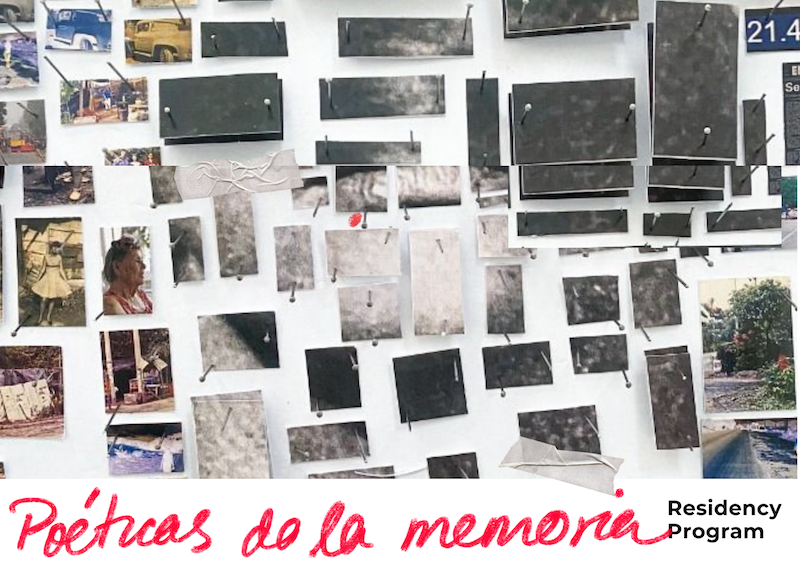
Located inside Haba ArtLab, our residency programs offer artists an opportunity to participate in a residency program «Poéticas de la memoria” through their work or research.
This program invites artists to reflect about
What is essence, and what is the experiential that the body learns? How is identity constructed, and what happens to it when memory collapses? In this residency program, we work with memory and forgetting as processes that continuously trace who we are. The stories we tell ourselves about what we have lived define our identity—or at least the version we choose to embrace. We do not exist in isolation; rather, we coexist with history and the fragile, domestic, and territorial memories that shape our place in the world.
This narrative choice is not always conscious, nor does it rely solely on memories. We forget at the same rate we remember: the brain operates within metabolic and spatial limits, discarding whatever it deems secondary. Yet, do we decide to erase out of pain or trauma? And in the face of the involuntary forgetting of neurodegenerative pathologies—where identity is reduced to an electrical hum stripped of any ordering narrative—to what extent do we cease to be? This call invites an exploration of the tensions between preservation, rewriting, the somatic imprint, and the erasure of memory.
For details about price and what is included in all our residency programs please follow the link below:
Application Due date: November 1, 2026
Program starts: November 23
Program ends: December 20
Read more: Full Open Call / Self Directed Program
November 2026 // 2027
Our goal is to advance the selected artists’ professional development by offering a supportive space for creative exploration. Up to 8 artists in residence will present their work in a Open Studio.
Participants are encouraged to collaborate with local art professionals, propose talks and workshops, and delve into Barcelona’s rich socio-cultural environment.
Below, we outline the central questions surrounding this theme along with inspirational references:
1. WE ARE WHAT WE REMEMBER: BETWEEN THE INNATE, THE BODY, AND THE NARRATIVE.
We are the result of an overlapping of layers: at the foundation, our innate essence and epigenetics (that which is written into the body before birth); above that, the pre-reflective drive (what the body learns and automates); and at the surface, reflective memory. All these factors are woven togethe retrospectively between what we remember and what we forget, forming an autobiographical fabric where identity is not a static object, but a construction continuously being rewritten.
Authors / Artists
Maurice Merleau-Ponty, Jean-Paul Sartre, Edmund Husserl, Bruce Nauman, Bas Jan Ader, Marina Abramović.
References
- Paul Ricœur: Narrative identity, sameness, and selfhood: Ricœur divides identity into two dimensions: sameness (idem, the biological and physical continuity of the body) and selfhood (ipse, narrative identity, the promise, and the biography that one weaves about oneself). Identity is constructed by chaining contingencies, losses, and choices into a coherent narrative.
- Henri Bergson: Habit-memory and pure memory. In Matter and Memory, Bergson distinguishes motor habit (the body's mechanical automatisms) from pure memory (the durée, or inner temporal flow). For Bergson, the brain acts as a filter selecting only what is useful for action; art emerges when this filter falters, allowing time to surface without intermediaries.
- Anselm Kiefer: Matter as an archive of time and scars
Kiefer addresses historical memory and identity through the physical density of his materials (lead, ash, straw, earth). His works function as palimpsests where matter preserves the scars of collective trauma, the ruins of the past, and the accumulation of temporal layers that refuse to disappear.
2. WHEN MEMORY COLLAPSES: THE CRUMBLING OF THE «SELF».
In contrast to ordinary biological forgetting (synaptic pruning to discard what is irrelevant), cognitive collapse and neurodegenerative diseases such as Alzheimer’s fracture narrative identity. When episodic memory crumbles, identity ceases to be a biography, turning into a disoriented physical presence, disconnected from its own past.
Authors / Artists
Catherine Malabou, Willem Utermohlen, Susan Aldworth, Marta de Menezes & Tony Oursler.
References
- Catherine Malabou: Destructive plasticity and The New Wounded: Malabou breaks with the traditional psychoanalytic view that trauma conceals a repressed memory. In organic brain damage, there is nothing to unearth: neuronal death enacts a destructive plasticity that does not merely alter the former subject, but creates a new individual—emptied of their past and incapable of sustaining psychic continuity.
- Willem Utermohlen: A visual record of Alzheimer's: Through the self-portraits painted as his disease progressed, Utermohlen documents the loss of spatial awareness, volume, and facial recognition (prosopagnosia). As neurons die, features blur: by losing autobiographical memory, the subject becomes incapable of sustaining his own image on the canvas.
- Susan Aldworth, Marta de Menezes & Tony Oursler: Mapping the mind: Aldworth and De Menezes shift memory toward the technical mapping of the brain (fMRI and cyanotypes), revealing the "self" reduced to patterns of oxygen consumption and synaptic firings. Oursler, for his part, projects distorted faces onto amorphous forms, staging minds trapped in neurochemical loops where identity is reduced to an electrical hum.
3. MEMORY THROUGH THE SENSES: THE INVOLUNTARY AND THE AMYGDALA.
Unlike the distance imposed by the gaze, the chemical and tactile senses operate from pure presence. Smell and taste bypass the analytical filter of the thalamus, connecting directly to the limbic system (amygdala and hippocampus). Involuntary sensory memory does not reconstruct the past as an abstract mental image, but relives it as an immediate physical impact.
Authors / Artists
Marcel Proust & Maurice Merleau-Ponty, Anicka Yi & Sissel Tolaas, Felix Gonzalez-Torres, Michael Rakowitz & Rirkrit Tiravanija.
References
- Marcel Proust & Maurice Merleau-Ponty: Involuntary memory and the lived body: Proust shows how a minimal sensory stimulus (the madeleine) triggers involuntary memory, bringing back intact lived experiences that reason had already forgotten. Merleau-Ponty complements this idea by explaining that the body inhabits space, storing mechanical and affective memories in the skin and joints, resurrecting existential states without the need for words.
- Anicka Yi & Sissel Tolaas: The politics of scent and bacterial memory: Yi investigates olfactory memory, the microbiome, and metabolic epigenetics, using fluids and bacteria to demonstrate that inherited identity is a living chemical ecology. Tolaas synthesizes aromatic molecules (fear, violence, vanished cities) to create olfactory archives that activate pre-verbal collective memories before reflective thought intervenes.
- Felix Gonzalez-Torres, Michael Rakowitz & Rirkrit Tiravanija: Taste as encounter and resistance: Gonzalez-Torres uses wrapped candies to transform the gesture of tasting into an act of affective communion and mourning. Rakowitz and Tiravanija turn food and cooking into tools of cultural resistance against historical forgetting, using recipes and shared spaces to metabolize collective trauma and activate dynamics of conviviality.
4. DOMESTIC MEMORIES: THE IMPORTANCE OF THE SMALL.
In contrast to official history—almost always rigid and written by the victors—there emerges the need to revisit narratives from below. Family stories, the flavors of a table, pains, traumas: histories that mark us at our core. When amplified, the murmur of domestic memory functions as a counter-monument that resists institutional erasure.
Authors / Artists
Walter Benjamin & Jacques Derrida, Marianne Hirsch & Guadalupe Maravilla, Natalia Ginzburg & Larissa Sansour.
References
- Walter Benjamin & Jacques Derrida: Brushing history against the grain and Archive Fever: Benjamin proposes rescuing the fragments of forgotten defeats before the official narrative seals them off forever. Derrida addresses archive fever by pointing out that memory relies on external supports to avoid dissolving, making every artistic record a trace inhabited by the absence of what is no longer there.
- Marianne Hirsch & Guadalupe Maravilla: Postmemory and somatic inheritance: Hirsch defines postmemory as the affective structure in which the children of survivors inherit collective trauma not as personal recollections, but as shadows that condition their present. Maravilla links his history as an undocumented migrant to the cancer he developed as an adult, creating instrument-sculptures (Disease Throwers) that treat illness as the somatization of inherited pain.
- Natalia Ginzburg & Larissa Sansour: Family language versus the official narrative: In Family Lexicon, Ginzburg reclaims idioms, private words, and domestic catchphrases as an intimate identity that resists the State archive. Through speculative fiction, Larissa Sansour (In Vitro) questions the weight of inherited memory, demonstrating how culture imposed upon the body can weigh just as heavily as biology itself in the construction of the future.
How to apply?
Send an email to spacehaah@gmail.com with:
CV and artístic experience.
Copy of your passport (must be valid for at least 3 months after the residency ends).
Portfolio (images, links to videos, or social media).
Project Proposal (summary, technical requirements, sketches, or references).
Email Subject: > «[Your Name] / Memory Residency at Haba ArtLab [Dates]»

Deja una respuesta