
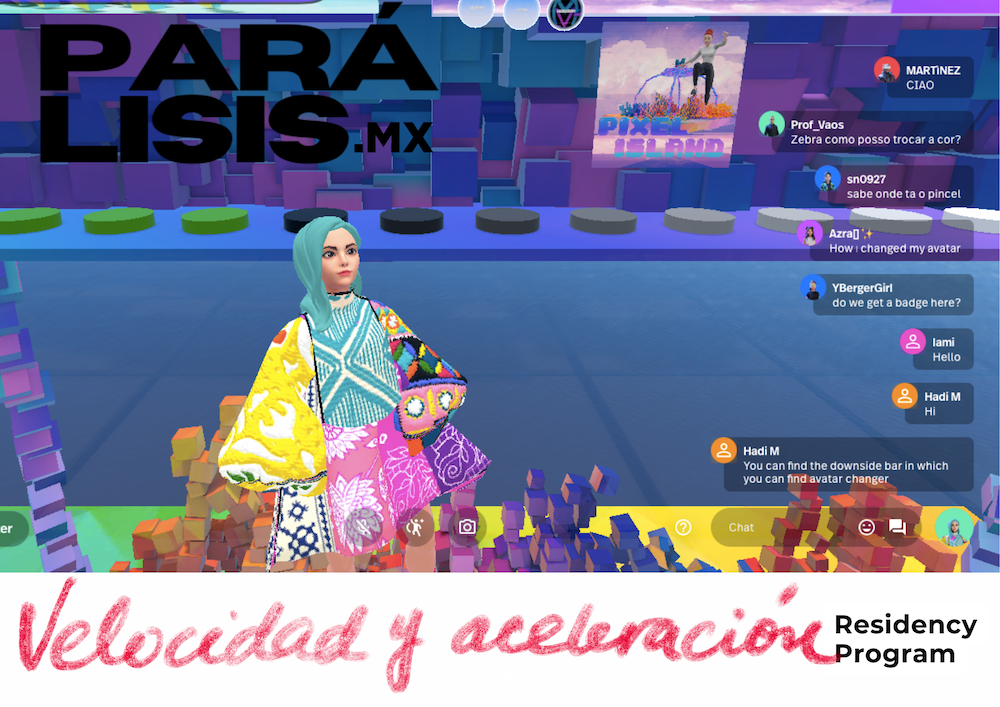
Velocity and aceleration
Program in collaboration with CEFC and Parálisis.mx
Located inside Haba ArtLab, our residency programs offer artists an opportunity to participate in a residency program «Velocity and acceleration in contemporary society” through their work or research.
This program invites artists to reflect on and interpret…
Within contemporary acceleration, reflection becomes an act of resistance against the pace that characterizes life in a hyperconnected world. We invite ourselves into calm and contemplation to interrogate the limits of speed within the human and our capacities for deceleration.
While life is movement, the speed and acceleration brought about by digitization and hyperconnectivity exceed our ordinary adaptation to the world. Through the experience of globalization, there emerges a need to reflect on the wear caused by the pace of information exchange, the movement of bodies, and media that, under an instrumented network of instantaneity, permeate today’s lived experience. Ultimately, on the temporality of the “now” and the transience (and probable void) that stems from it.
Application Due date: Enero 25, 2027
Program starts: Febrero 2
Program ends: Marzo 21
For details about price and what is included in all our residency programs please follow the link below:
Read more: Full Open Call / Self Directed Program
March 2027
Our goal is to advance the selected artists’ professional development by offering a supportive space for creative exploration. Up to 8 artists in residence will present their work in a Open Studio.
Participants are encouraged to collaborate with local art professionals, propose talks and workshops, and delve into Barcelona’s rich socio-cultural environment.
Below, we outline the central questions surrounding this theme along with inspirational references:
1. DROMOLOGY AND THE LIMITS OF THE HUMAN.
Inhabiting a hyperconnected world entails constantly clashing with the biological, cognitive, and affective boundaries of the body. In an era where technology promotes an immediacy without pauses, geographical distance loses weight and the experience of time is compressed into a continuous present devoid of depth. This axis investigates the frenetic race of devices, examining the natural tension between the accelerated pace of technological apparatuses and our body’s actual capacity to process life.
Authors / Artists
Paul Virilio, Hartmut Rosa, Jonathan Crary.
References
- Paul Virilio: Dromology and the tyranny of real time: Virilio defines dromology (the logic of speed) as the true driving force of modernity. The absolute speed of fiber-optic networks compresses physical distances to the point of erasing them, reducing experience to "real time." For Virilio, this constant acceleration atrophies our perception: the capacity to contemplate and wait is replaced by instantaneous impulse and the threat of the continuous accident.
- Hartmut Rosa: Social acceleration and temporal alienation: From the perspective of critical sociology, Rosa demonstrates how technological innovations have not granted us more free time, but have instead accelerated our pace of life. This generates a "temporal alienation": a difficulty in connecting genuinely with places, objects, and people, turning everyday life into a frenetic accumulation of moments devoid of duration or affective imprint.
- Jonathan Crary: 24/7 and the eradication of pauses: Crary analyzes how contemporary capitalism seeks to eliminate the body's natural rest in order to maintain a global market that never sleeps. Repose, inactivity, and sleep become the last unconquered spaces of resistance against the demand to remain perpetually visible and productive.
2. THE INSTRUMENTED NETWORK: OVERLOAD, INFOCRACY, AND THE VOID.
Digital immediacy often replaces narrative depth and shared memory with a constant flow of alerts, news, and disconnected images. The greater the volume of circulating information, the harder it becomes to interpret, and the more barren meaning becomes. We ask ourselves how this informational excess transforms public space into a territory of noise, disorientation, and existential void.
Authors / Artists
Byung-Chul Han, Franco «Bifo» Berardi, Hito Steyerl.
References
- Byung-Chul Han: Infocracy and the erosion of meaning: Han points out that our society is governed by infocracy (the regime of information), where unbridled data traffic generates noise rather than clarity. Immediacy destroys narrative, silence, and the quiet listening required by any search for truth, leaving behind only bursts of stimuli that feed collective amnesia.
- Franco "Bifo" Berardi: Semiocapitalism and the collapse of attention: Berardi explains how the data flow of the infosphere has ultimately saturated our nervous system. This continuous overstimulation overwhelms attentional capacity, triggering episodes of anxiety, exhaustion, and affective detachment, while wearing down empathy and presence in physical encounters.
- Hito Steyerl: The circulation of the "poor image": Steyerl theorizes on those accelerated, compressed images shared thousands of times across networks. The "poor image" sacrifices technical quality to gain speed of circulation, becoming the visual reflection of a culture where immediate flow matters more than the permanence of the artwork or the museum archive.
3.BODILY WEAR AND RESISTANCE.
With the obsession with algorithmic efficiency and performance, this section explores the physical, emotional, and material marks that technological haste leaves on people and the planet. The immateriality of the network is merely an illusion resting upon infrastructures of intensive extraction and exhausted bodies. We propose viewing fatigue or the glitch not as errors to be corrected, but as necessary fissures for resistance.
Authors / Artists
Legacy Russell, Yuk Hui, Kate Crawford & Vladan Joler.
References
- Legacy Russell: Glitch Feminism and technical interruption: Russell employs the glitch (the unforeseen error of the machine) as a political resource for resistance. The failure disrupts the inertia of the productive system, opening an interstice where we can slow down the demands of efficiency and reimagine our identities beyond the norm.
- Yuk Hui: Cosmotechnics and the plurality of times: Hui proposes questioning the singular, linear conception of technology inherited from the West. Cosmotechnics invites us to connect technical development with specific moral, cultural, and territorial values, offering alternative pathways to curb the uniform acceleration of global capital.
- Kate Crawford & Vladan Joler: Anatomy of an AI System: Through a materialist lens, Crawford and Joler map the invisible infrastructure that sustains digital immediacy: from lithium mining and the ecological footprint to precarious human labor, demonstrating that the speed of the virtual environment relies on a tangible consumption of real-world resources.
4. CONTEMPLATION AS CREATIVE PARALYSIS.
The mandate of incessant movement and immediate reaction, deliberate stillness and contemplation proposed as an «active paralysis.» Halting the machinery of production does not signify passive inactivity, but rather opening a poetic space-time to reclaim presence, sensibility, and direct contact with matter.
Authors / Artists
Claire Bishop, Bernard Stiegler, John Cage.
References
- Claire Bishop: The return to presence and tactile aesthetics: Bishop reflects on how artistic practices respond to virtualization and the speed of screens by returning to physical presence, the corporeal, and analog methodologies. The body and matter impose a deliberate pace of observation that challenges the transience of the digital environment.
- Bernard Stiegler: Technics as pharmakon: Stiegler analyzes technology as a pharmakon (both cure and poison). Although the speed of media erodes the living memory of experiences, artistic practice can intervene in these very devices to transform them into tools for deep attention, pause, and collective care.
- John Cage: Silence and deep listening: In the realm of sound and the perception of time, Cage reminds us that silence is not the absence of sound, but the suspension of intentional noise to open ourselves to our surroundings. Contemplation arrests haste, allowing us to inhabit time through calm and attentive listening.
How to apply?
Send an email to spacehaah@gmail.com with:
CV and artístic experience.
Copy of your passport (must be valid for at least 3 months after the residency ends).
Portfolio (images, links to videos, or social media).
Project Proposal (summary, technical requirements, sketches, or references).
Email Subject: > «[Your Name] / Velocity Residency at Haba ArtLab [Dates]»


Deja una respuesta